

1 / 8
ERA
Did you know
Released 23 years ago.
MoodPlayr · trivia#01

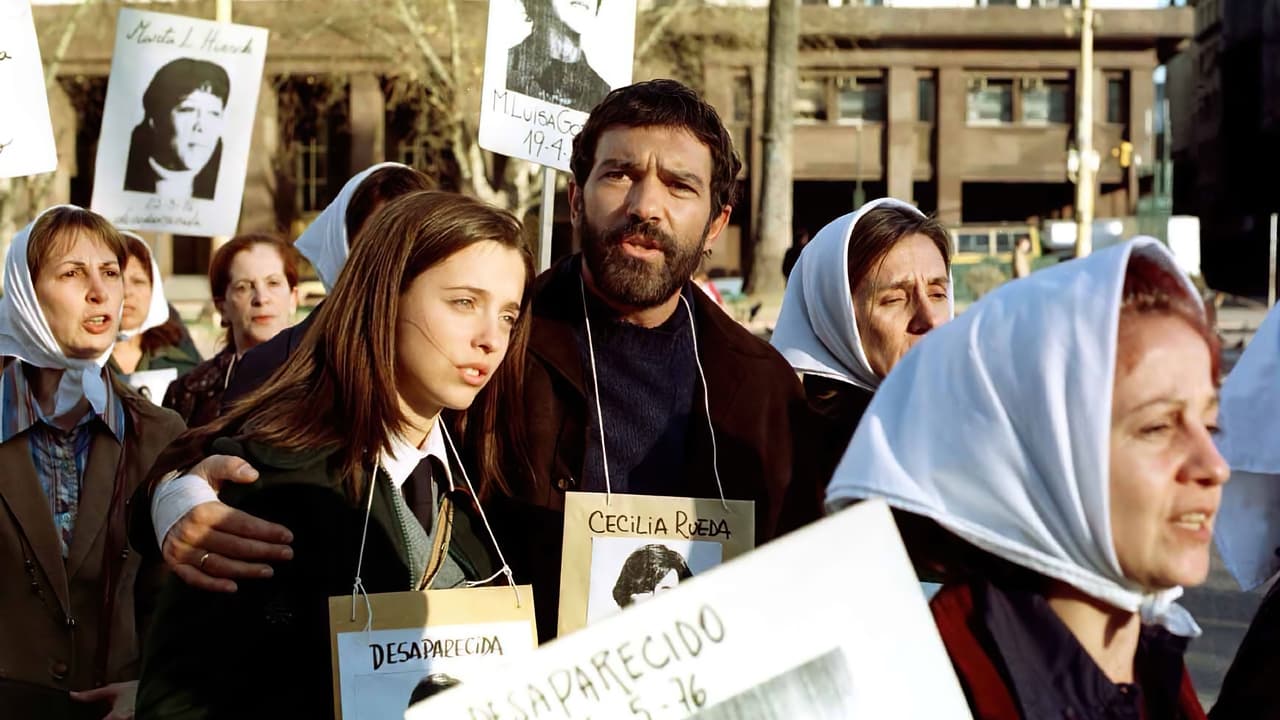
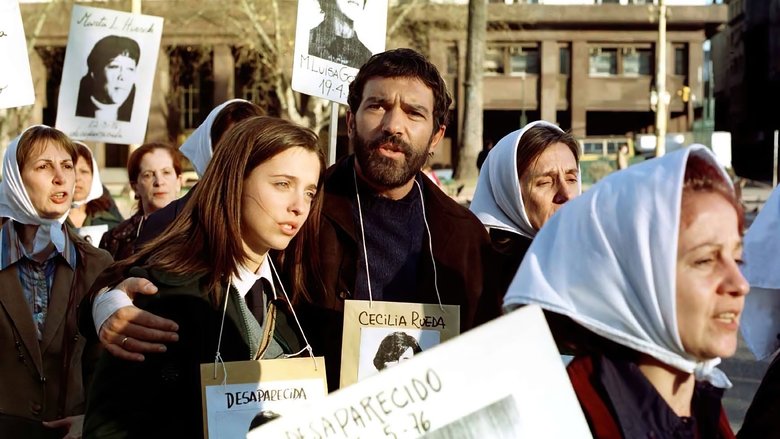
Set during the unsettling disappearances in Buenos Aires during the dictatorship of the 1970s, the film involves theater director Carlos Rueda and his wife Cecilia. Shortly after Cecilia writes an editorial commentary questioning the mysterious abductions, she is herself abducted and taken into police custody.
“Some stories are better left unspoiled.”
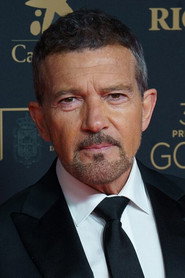
Antonio Banderas
Carlos Rueda

Emma Thompson
Cecilia Rueda

Leticia Dolera
Teresa Rueda

Maria Canals-Barrera
Esme Palomares

Rubén Blades
Silvio Ayala

Irene Escolar
Eurydice
Fernando Tielve
Orfeo / Enrico

Héctor Bordoni
Pedro Augustín
Credits
Want more? Switch to Cinephile mode in the header for DP, composer, budget, box office, production companies, keywords, and release history.
Did you know?
Did you know
Released 23 years ago.
Did you know
Dialogue crosses 2 languages: English, Spanish.
Did you know
International production across 3 countries: Spain, United Kingdom, United States of America.
Did you know
Directed by Christopher Hampton, shot by Guillermo Navarro. Note their partnership — DPs and directors often return to each other across a career.
Did you know
Original score by George Fenton. Worth a dedicated listen after — most great films lose half their impact without the score.
Did you know
Editor George Akers shaped the rhythm. On an edit-heavy film, the editor does more to control your pulse than the director.
Did you know
Antonio Banderas and Emma Thompson and Leticia Dolera carry the top of the cast.
Did you know
IMDB entry: tt0314197 — still the authoritative cross-reference for credits and trivia.
Cinephile deep dive
Christopher Hampton directs. Guillermo Navarro behind the camera. George Fenton scores. George Akers cuts. Produced in Spain, United Kingdom, United States of America. Dialogue in English, Spanish.
Trivia
Also by
Community reviews
Imagining Argentina could only be imagined by a perversely ignorant mind. Since its director/screenwriter is Christopher Hampton, who before and after has adapted the screenplays of Dangerous Liaisons, Mary Reilly, The Quiet American, and The Father, I can only blame Lawrence Thornton, whose novel inspired (though perhaps a better word would be instigated) this vile piece of crap. The film takes place in 1977, in an Argentina where everyone speaks English with a wide range of Hispanic and Latin American accents, none of which sound remotely Argentinian. The exception is Emma Thompson, who uses her natural British accent even though her character's name is Cecilia Rueda. She is a dissident journalist in Buenos Aires; after publishing an article denouncing the forced disappearance of students protesting bus fares, Cecilia is kidnapped by the secret police. Faced with the indifference, and almost certain complicity, of the authorities, her husband Carlos (Antonio Banderas) puts up posters with Cecilia's photo, but I doubt that these are of any use, considering that the information on them is printed in Spanish and here everyone, as I just noted, speaks English. This linguistic dissonance, however, is not the most outrageous aspect the movie. Oh no; that dubious honor is reserved for the fact, and I swear I'm not making this up, that Carlos happens to be psychic. Really. Carlos is producing a play for a youth theater troupe, and one fine day, completely out of the blue, he tells one of the actors that his father, who was also kidnapped, will be released later that night. “It was as if I was remembering the future,” he explains to his friend and colleague Silvio (Rubén Blades, who that same year appeared in Once Upon a Time in Mexico; who would have imagined that the latter would be the more realistic of the two). The whole thing is like a cross between Tell Me How I Die and the Saturday Night Live episode where Chris Walken is a "trivial psychic," except that there’s nothing trivial about state terrorism in Argentina in the 1970s and 1980s. Carlos's prediction comes true, which could very well have been a coincidence; however, he never questions his new powers and soon summons the Mothers of Plaza de Mayo to reveal the fate of their loved ones. All of this is extremely insensitive, offensive, and disrespectful. Not only does it minimize an enormous tragedy, but on top of that, whether deliberately or not, effectively calls it into question. Let's say that Johnny Moviegoer does not know the full extent of the atrocities committed during the last dictatorship in Argentina, but he is fully aware that in real life no one can "remember the future"; now, if the movie indiscriminately exaggerates the latter, who could blame Johnny for assuming that the former is likewise pure hyperbole? As it is, the graphic scenes of rape and torture presented in the film are gratuitous because they do not take place in a medium that bears any resemblance to the real world. Films like Night of the Pencils and The Official Story are vastly superior not only because they were written in Spanish and directed and acted by Argentines, but above all because they take their material very seriously. Imagining Argentina is, and this is the lesser of its evils, unnecessary, but since they felt compelled to do it, why not change Carlos from a real psychic to a charlatan who slowly changes his attitude as he becomes more familiar with the stories of the people he’s scamming? That way it wouldn’t be the filmmakers the ones who end up coming across as swindlers.
Production companies
Multivideo

Myriad Pictures
US
Green Moon Productions
ES
Mike's Movies
US
Themes & keywords
Release history · US
Also known as